
Client
School District 78 (Fraser-Cascade)
Location
Hope, BC
As electrification accelerates across British Columbia, many communities are facing growing pressure on local electrical infrastructure. For School District 78 (Fraser-Cascade), planned building upgrades and increasing electricity requirements at Hope Secondary School created an opportunity to explore innovative energy solutions that could support both the school’s needs and the broader electrical grid. To better understand these opportunities, the District partnered with Prism Engineering to conduct a Battery Energy Storage System (BESS) feasibility study.
Challenge
Balancing growth, resilience, and grid constraints
Hope Secondary School had previously been identified as a facility with opportunities for load management and distributed energy solutions through a Load Management Audit completed by Prism Engineering in 2022. As the District considered future facility upgrades and increasing electrification, it needed a clearer understanding of how battery storage could support both operational and strategic objectives.
The District, were interested in evaluating several key questions:
- How much could battery storage reduce peak electrical demand at the school?
- Could a BESS provide backup power and improve operational resilience?
- Would battery storage help maximize the value of future solar PV generation?
- Could energy storage help defer upgrades to local electrical infrastructure?
- What battery size, configuration, and location would provide the best overall value?
- Can BESS help alleviate regional grid constraints during peak demand periods?
Answering these questions required detailed analysis of electrical demand patterns, future load growth, integration requirements, and financial performance.
Solution
A data-driven evaluation of battery storage opportunities
With extensive experience delivering battery storage, demand response, and distributed energy resource studies for utilities and major organizations including BC Hydro, Nelson Hydro, BC Ferries, and Seaspan, Prism Engineering was selected to assess the technical and economic feasibility of a BESS at Hope Secondary School.
Prism conducted a structured feasibility assessment that combined facility-specific analysis with broader grid and operational considerations. The work included:
- Stakeholder and project alignment through a project kick-off process to confirm objectives, priorities, and success criteria.
- Comprehensive data gathering, including electrical utility data, facility documentation, previous studies, and information on planned building upgrades.
- Electrical demand analysis using historical load profiles to identify peak demand characteristics and opportunities for load management.
- Future load modelling to understand how planned HVAC and facility improvements, including solar PV systems, could affect electrical demand.
- Evaluation of multiple battery storage scenarios, comparing different system capacities and operational strategies.
- Assessment of system integration requirements, including controls, building management systems, utility communications, fire safety considerations, and solar PV compatibility.
- Financial and capital planning analysis, including cost estimates, net present value (NPV) calculations, and simple payback evaluations to support decision-making.
The study also examined spatial and infrastructure considerations to ensure any future installation could be successfully integrated into the existing school environment while supporting long-term operational goals.
Outcome
A roadmap for informed battery storage investment
The feasibility study provided School District 78 with the technical and financial information needed to evaluate the role of battery energy storage at Hope Secondary School. Through detailed analysis, the District gained a clearer understanding of potential battery configurations, capital requirements, operational impacts, and implementation considerations.
- Analysis of existing and future electrical demand requirements.
- Evaluation of multiple battery storage system configurations.
- Battery sizing recommendations, including minimum, optimal, and maximum scenarios.
- Capital and operating cost estimates.
- Financial analysis supporting investment decisions.
- Assessment of backup power, peak demand management, solar integration, and infrastructure deferral opportunities.
The study helped establish the foundation for moving from concept to implementation. Building on the feasibility study findings, School District 78 subsequently engaged Prism Engineering to provide design and implementation support for a battery energy storage project at Hope Secondary School with BC Hydro providing funding of up to 90% through the Energy Storage Incentive (ESI) program. The installation is on track to be completed and put into operation by Fall 2026, just in time for BC Hydro winter peak season.
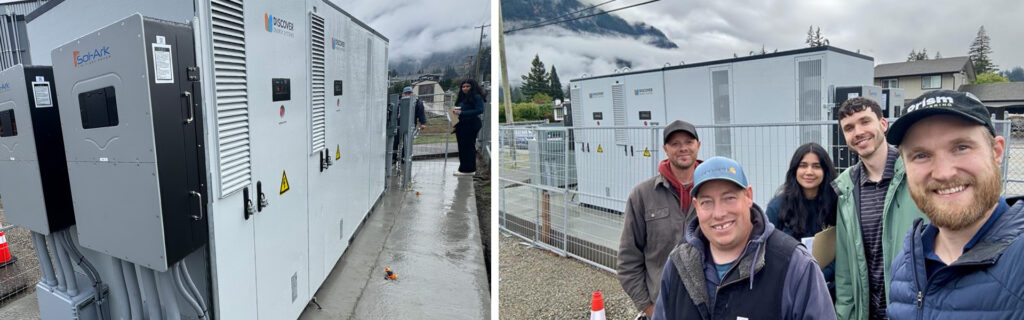
Photos: Battery Storage System Installation and Site Visit with the project team: (Right to left ) Adam Franklin, Nick Carter, Nafeesa Nawar and SD78 staff.
Lessons for organizations considering battery storage
Battery storage is attracting growing interest from organizations preparing for a more resilient future. Hope Secondary School demonstrates the value of beginning with a feasibility study to understand opportunities, constraints, costs, and risks before committing capital.
Whether your goals include reducing electrical demand, improving resilience, integrating renewable energy, or deferring infrastructure upgrades, Prism Engineering can provide the technical expertise and practical guidance needed to move forward with confidence.
–
Top Banner images: Battery Storage System interior and exterior and Nafeesa touring the solar photovoltaic system at Shxwelis te Ts’qó:Is — Spirit of Hope Secondary School
Related Resources
Service
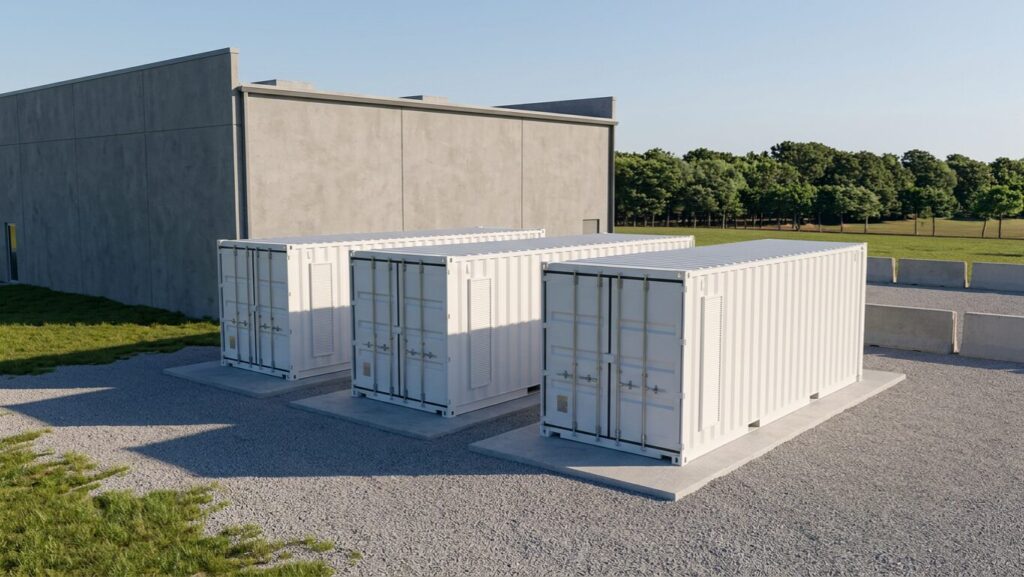
Battery Energy Storage Systems (BESS) Battery Energy Storage Systems (BESS) are increasingly being evaluated by property, energy, and… Read more
Project
Vancouver School Board | Recommissioning In 2022, the Vancouver School Board (VSB) contacted Prism Engineering to investigate and develop… Read more
Project
St. George’s School | Building Operations Assessment As the COVID-19 or SARS-CoV-2 global pandemic continues to threaten public health around the… Read more